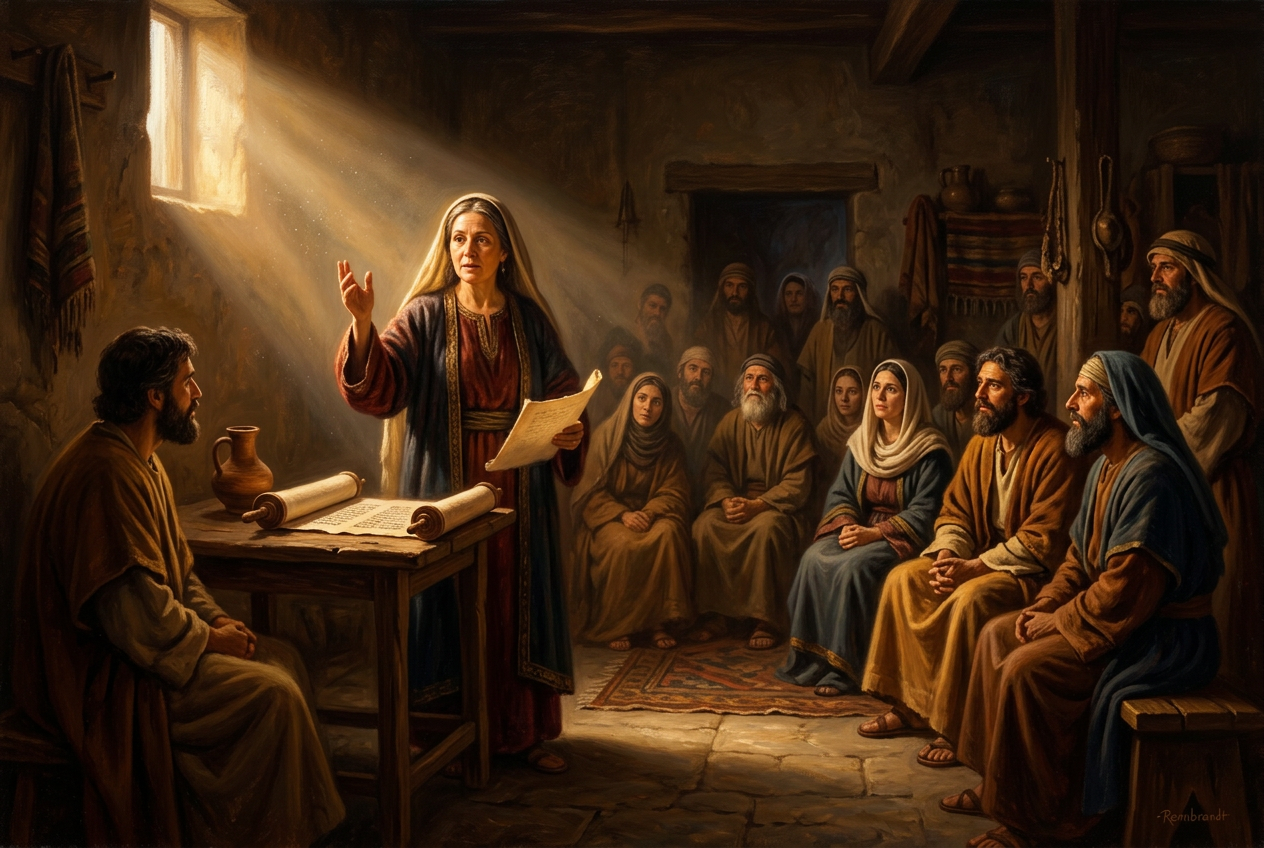
Why Paul Praised a Female Apostle After Telling Women to Keep Silent
Can women preach? The church has argued over that question for hundreds of years, and two lines from Paul's letters sit at the center of the fight. On a 2026 episode of Discovering Truth with Dan Duval, Daniel Duval takes the question head on and states his position in the first minute: God calls women to ministry, and Scripture itself makes the case. Watch the full teaching to hear him lay out the whole argument in his own words.
His argument turns on a habit most readers never notice. People quote one line of a letter and skip the rest of the page. Read the whole page, Duval teaches, and the picture changes. This summary hits the highlights; see the whole episode for the verse-by-verse walkthrough.
Does the Bible Forbid Women From Preaching?
Two passages carry almost all the weight in this debate. The first is 1 Corinthians 14:34 (NKJV): "Let your women keep silent in the churches, for they are not permitted to speak; but they are to be submissive, as the law also says." The second is 1 Timothy 2:12 (NKJV): "And I do not permit a woman to teach or to have authority over a man, but to be in silence."
That is heavy language, and Duval does not pretend otherwise. Instead he begins where Paul begins: with worth. Ephesians 2:19-21 describes every believer, male and female, as living parts of one holy temple of God. Jesus died equally for men and for women, so the question was never about value or qualification. The real conversation, Duval explains, is about function: how God orders ministry inside a community.
That view shapes daily life at Bride Ministries. Nearly all of the ministers on the Bride Ministries coaching staff are women.
What Does "Keep Silent" Actually Mean?
The Greek word behind "keep silent" is sigao. In plain terms it means get quiet at the right moment, not stay mute for life. Paul uses the same word twice more in the same chapter, once for a tongues-speaker with no interpreter and once for a prophet yielding the floor. Nobody treats those verses as lifetime gag orders on men.
Duval compares it to a classroom where half the students talk over the teacher. Nothing gets learned. Paul was restoring order, not sewing mouths shut.
One more detail may be the strongest point of the episode. When Paul addresses the "brethren," he uses the Greek word adelphos, meaning "from the same womb." It covers brothers and sisters alike. In 1 Corinthians 14:26, Paul tells the adelphos that each one arrives with a psalm, a teaching, a tongue, a revelation. Read plainly, Paul expects women to teach and prophesy when believers gather. The gifts God gives every believer were never the problem. The disorder was.
Was 1 Timothy 2 About Pulpits or About Marriages?
So what about "I do not permit a woman to teach or to have authority over a man"? Duval zooms in on the word translated "man": the Greek aner. He notes it appears 215 times in the New Testament, and in roughly 50 of those places it plainly means husband. In his view, translators stretched a household word into a church-wide rule.
Read it as "her husband" and the verse matches everything else Paul wrote about how God designed marriage to work: authority flows from God to Christ to the husband to the wife. That flow sets order in a home. It does not shrink a wife's worth, and it says nothing about a pulpit.
Daniel spends several minutes tracing this one Greek word through the New Testament on screen, and the episode makes the case far more thoroughly than a summary can.
Women Held Every Office in the New Testament
Then the teaching goes on offense. Duval walks through the five ministry offices Paul lists in Ephesians (apostles, prophets, evangelists, pastors, and teachers) and names a woman in each one.
- Teacher. Priscilla, alongside her husband Aquila, corrected and trained the powerful preacher Apollos (Acts 18).
- Pastor. No one in the New Testament is ever called "Pastor" by name, Duval observes, yet Tabitha, called Dorcas, shepherded her town of Joppa through good works (Acts 9:36).
- Evangelist. The woman at the well told her whole village that Jesus was the Messiah (John 4), before Philip ever carried the title.
- Prophet. "Now this man had four virgin daughters who prophesied" (Acts 21:9, NKJV), written of Philip's girls. Centuries earlier, Miriam prophesied (Exodus 15:20) and Deborah judged Israel (Judges 4:4).
- Apostle. Romans 16:7 (NKJV) reads, "Greet Andronicus and Junia, my countrymen and my fellow prisoners, who are of note among the apostles." Junia is a woman's name, and Duval points out that some translators changed it to "Junias" so it would look like a man's.
One line of a letter says silence. The rest of the book shows women preaching, prophesying, teaching, and leading with God's blessing.
Can Women Preach? Yes, and Order Still Matters
Duval lands the episode on Galatians 3:28 (NKJV): "There is neither Jew nor Greek, there is neither slave nor free, there is neither male nor female; for you are all one in Christ Jesus." God releases women into ministry. He also loves order: wives honoring husbands, gatherings honoring whoever is ministering, gifts released one at a time so everyone grows.
This is only the outline. Press play on the video below and let Daniel walk you through every verse himself, in full. And if this stirred a calling in you, Bride Ministries Institute trains men and women alike to serve with the gifts God placed inside them.
Take the Next Step Toward Healing
Learn More