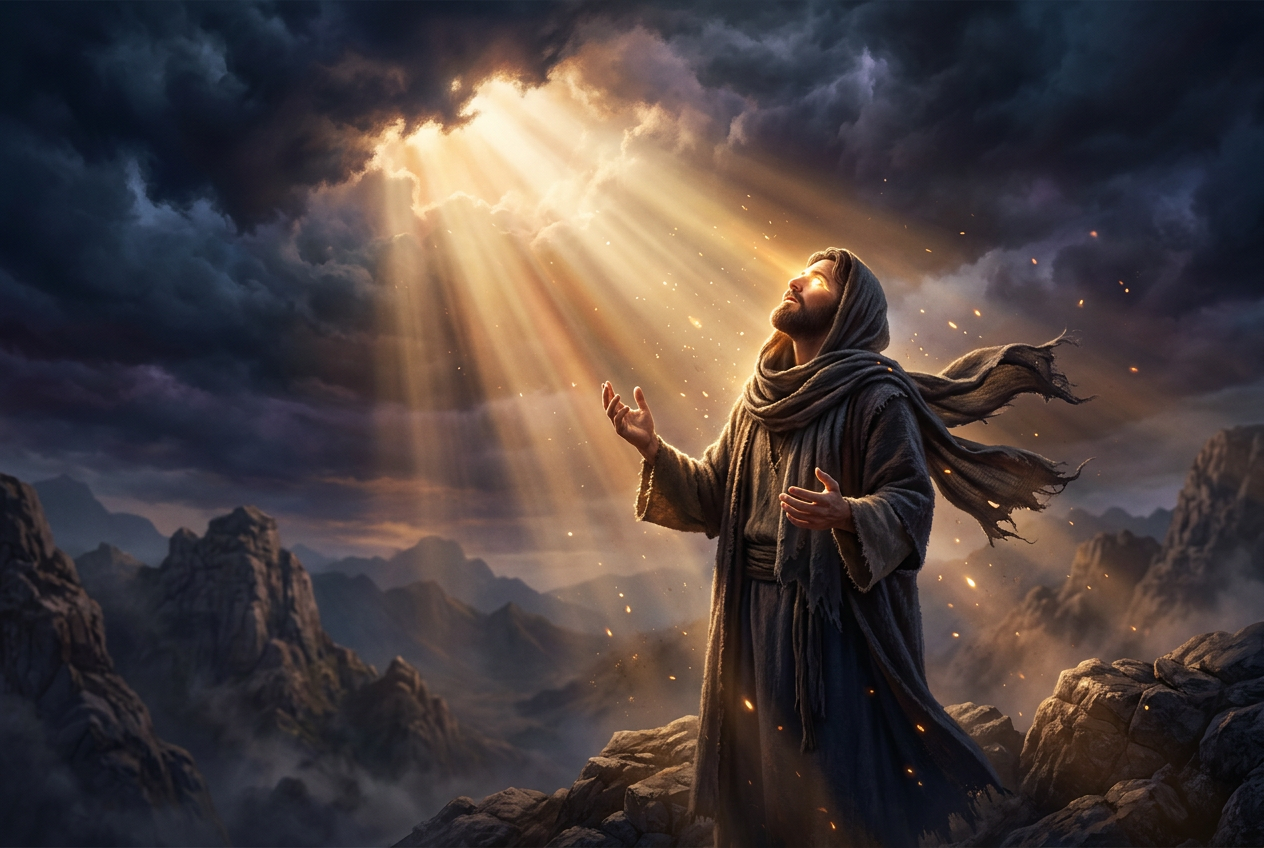
You Can Have Eyes and Still Not See: The Vision God Wants You to Have
Two people can sit in front of the very same thing and see two completely different things. One looks at a muddy field and sees a mess. The other looks at the same field and sees a harvest. The difference is not their eyesight. It is something deeper, and the Bible has a name for it.
Daniel Duval, the founder of Bride Ministries, teaches that this deeper kind of seeing is one of the most important things a believer can grow in. He calls it spiritual vision. And he teaches that real spiritual vision never stays a private thing. It always pulls people together. Vision and unity belong to each other.
What Are the Three Kinds of Vision?
The first kind of vision is the one most people think of: physical eyesight. You see a golden brick, you say "golden brick." You see a pile of cow manure, you say "cow manure." That is true, and it is useful, but it is not the deepest kind of seeing there is.
The Bible points to something more. Paul prays that believers would have the eyes of a different part of them opened.
“the eyes of your understanding being enlightened; that you may know what is the hope of His calling, what are the riches of the glory of His inheritance in the saints, (Ephesians 1:18)”
The "eyes of your understanding" is a picture of seeing with more than your eyeballs. It is seeing the meaning, the worth, and the possibility inside a thing. With that kind of sight, the same person looks at the golden brick and sees a resource that could build something. They look at the pile of manure and see fertilizer that could grow a field.
That leaves three kinds of vision in all. There is no vision, where a person sees only the surface. There is limited vision, which is real but runs on human cleverness alone. And there is God's vision, which only comes from Him. The last two both beat having no vision. Only one of them needs God.
Can a Person Have Eyes and Still Not See?
Yes, and Scripture says it plainly. God once spoke to a stubborn people this way:
“'Hear this now, O foolish people, Without understanding, Who have eyes and see not, And who have ears and hear not: (Jeremiah 5:21)”
Their eyeballs worked fine. What had shut down was the seeing on the inside. Daniel Duval teaches that this kind of blindness is not rare. A person can read the Bible, attend church, and still walk through life seeing only the surface of things, missing what God is doing right in front of them.
This is why vision matters so much for faith. Wisdom literature warns:
“Where there is no revelation, the people cast off restraint; But happy is he who keeps the law. (Proverbs 29:18)”
Older Bibles translate that first phrase as "where there is no vision, the people perish." The idea behind it is the same. When people cannot see what God sees, they lose their grip and fall apart. Daniel Duval puts it bluntly: a faith with no vision is a faith that is slowly dying.
Is Going to Church the Same as Having Vision?
Here is a hard but freeing point Daniel Duval makes. Some people believe the Christian life is mostly saying a prayer at the start and then showing up to a service every week. Faithful church attendance is a good habit. It is not the same thing as God's vision for your life.
God never meant your faith to peak at a Sunday meeting. He has a specific vision for you, and you are responsible to chase it. That is a big reason so many believers feel stuck. They have the habit without the vision, the routine without the picture of where God is taking them.
This is also worth saying gently. For many people, the reason they cannot see is not laziness. Old wounds, hard seasons, and lies they absorbed early in life can cloud the inner eyes. If that is you, growing in vision may take some honest healing, not just more effort. That is normal, and it is not a failure of faith.
Why Does Vision Need Unity?
Now the two halves of this teaching come together. Look closely at any big change that ever swept through a society. It almost always started with a few people who could see something nobody else could see. But the change itself never came from those few alone. It came when many people caught the same vision and moved together. Vision starts small. It cannot happen without a crowd.
Daniel Duval teaches that this is exactly why he gives so much of his life to unity in the body of Christ. The unity is not the goal by itself. It is the means. A bigger vision sits behind it. He often describes a coming season when the world will be shaken: rising natural disasters, deep cultural confusion about what it even means to be human, and a real spirit of opposition to God growing bolder. Jesus said as much about the days before His return.
“For nation will rise against nation, and kingdom against kingdom. And there will be famines, pestilences, and earthquakes in various places. All these are the beginning of sorrows. (Matthew 24:7-8)”
Daniel Duval teaches that the answer to a shaking world is not fear and not hiding. The answer is a church that can see what is coming, knows who it is, and stands together. Knowledge over fear. He points toward what he calls sheep nations: whole regions where the kingdom of God truly rules in the hearts of people, places of supernatural peace and provision while the rest of the world is in turmoil. That kind of thing is far too big for any one believer or any one church. It can only happen if God's people come together.
The Two Kinds of Unity
Daniel Duval makes a helpful distinction between two layers of unity. The first he calls the unity of the Spirit. The moment a person is joined to God, something real happens on the inside.
“But he who is joined to the Lord is one spirit with Him. (1 Corinthians 6:17)”
Every believer is already one in spirit with God and, through Him, with every other believer. That part is a gift, not a project. The work is to guard it.
“endeavoring to keep the unity of the Spirit in the bond of peace. (Ephesians 4:3)”
The second layer is the harder one. Daniel Duval calls it the unity of the faith: believers actually agreeing on truth and moving in the same direction, not just across a single church but across cities and nations. That is the unity Paul described as the finish line.
“till we all come to the unity of the faith and of the knowledge of the Son of God, to a perfect man, to the measure of the stature of the fullness of Christ; (Ephesians 4:13)”
He often points out how big and clear this picture is. It is so large that no human strategy could pull it off, which is exactly how you know it comes from God. And it sits at the very heart of what Jesus prayed for His people on the night before the cross, asking the Father "that they all may be one" so the world would believe (John 17:21). Unity is not a nice extra. It is the Father's own desire.
Where to Start
You do not have to start by changing the whole church. You start by asking God to open the eyes of your understanding, the way Paul prayed, and then by refusing to settle for surface-level seeing. You start by treating the believers around you as people you are already one with in spirit, even when you do not yet agree on everything.
For some, the inner eyes stay clouded no matter how hard they pray, because the fog comes from real pain that was never healed. That is not a wall of faith you can push through by trying harder. It is something that gentle, deeper healing can reach, and you were never meant to face it alone. Bride Movement built a free healing assessment for exactly this. It takes about two minutes, it is private, and it points you toward the next step.
Start Your Healing Journey
Take the Free Assessment