The Question Every Christian Has Asked About December 25
Someone told you Christmas is a pagan holiday. Maybe it was a video, a podcast, or a friend who walked away from church. The claim lands like a charge filed against something you love, and if you follow Jesus, it can unsettle you.
So let us put the claim on the stand. This piece weighs three things: what the historical record shows about December 25, what the Bible rules about holidays and conscience, and why the birth of Jesus towers over the pagan-origins debate.
Where Does the "Pagan Holiday" Claim Come From?
Most of the "Christmas is a pagan holiday" case rests on a handful of historical exhibits. Line them up, cross-examine each one, and they start to wobble. They are weaker than they first sound.
The Saturnalia Theory
Saturnalia was a Roman festival honoring the god Saturn, and the calendar hands Christmas an alibi. Saturnalia ran December 17 to 23. Christmas falls on the 25th. The festival packs up two days before the birthday it supposedly started. A holiday that ends on the 23rd makes a poor origin for December 25.
Sol Invictus and December 25
Others point to Sol Invictus, the "Unconquered Sun," a Roman sun cult. Around the year 274, a festival for the sun god landed on December 25, and critics say the church simply copied it. Historians, though, are nowhere near agreement. Many now argue the evidence for borrowing runs thin, and that the influence may even flow the other way, from church to empire. Call it what it is: the case is contested, not proven.
The Calculation Idea
A simpler possibility rarely makes the videos. Early Christians may have reached December 25 on their own, counting forward from the date they believed Jesus was conceived, around March 25. No one can put His exact birthday on the record, and Scripture never enters it into evidence. That absence is no scandal. It is an open question, and open questions are allowed to stay open.
What the Bible Actually Says About Holidays
Now the case moves to a higher bench, and this is where the anxiety can finally settle. The Bible already anticipated this exact argument, and it refuses to put the weight where the critics stack it.
Paul spoke to this directly about special days: "One person esteems one day above another; another esteems every day alike. Let each be fully convinced in his own mind. He who observes the day, observes it to the Lord; and he who does not observe the day, to the Lord he does not observe it" (Romans 14:5-6). Notice what he refuses to do. He never stamps the day clean or unclean. He points past the date to the heart behind it.
He goes further and warns against turning these things into weapons: "Therefore let us not judge one another anymore, but rather resolve this, not to put a stumbling block or a cause to fall in our brother's way" (Romans 14:13).
Paul is even more direct in another letter: "So let no one judge you in food or in drink, or regarding a festival or a new moon or sabbaths, which are a shadow of things to come, but the substance is of Christ" (Colossians 2:16-17). The issue was never the date on the calendar. The issue is who you are worshiping, and with what heart. One line steadies the whole question: "whether you eat or drink, or whatever you do, do all to the glory of God" (1 Corinthians 10:31).
Why Does Darkness Attach to Certain Dates?
If the date is not the issue, a quiet unease still creeps in for some. They sense a spiritual charge on certain seasons of the year. The instinct is not silly, and Bride Ministries does not wave it off.
Start with the reassurance. God made the seasons, the sun, and the stars, and He called them good. The seasons belong to Him. True enough, occult and pagan systems have long wrapped themselves around the natural calendar, especially the solstices and equinoxes, the hinges of the year. Bride Ministries teaches that these turning points have been treated as high days in occult practice, because so much of that world is built around the cycles of the sun, moon, and stars. If you want to understand how those systems work, Bride Ministries has a full teaching on what Kabbalah actually is.
The deeper point is ownership. The enemy attaching himself to a date does not make the date his. He is a squatter, not the owner. Scripture shows this pattern from the beginning, when pride first tried to steal what belonged to God alone, a story Bride Ministries traces in the fall of Lucifer. The darkness copies and counterfeits. It cannot create.
Your worship, then, is not a retreat. It is a repossession. When you lift up Jesus on December 25, you are not borrowing the enemy's day. You are taking back ground that carried His name all along. No stretch, no reach. It is exactly what the birth of Jesus was from the start.
Hidden in Plain Sight: What the Nativity Really Shows
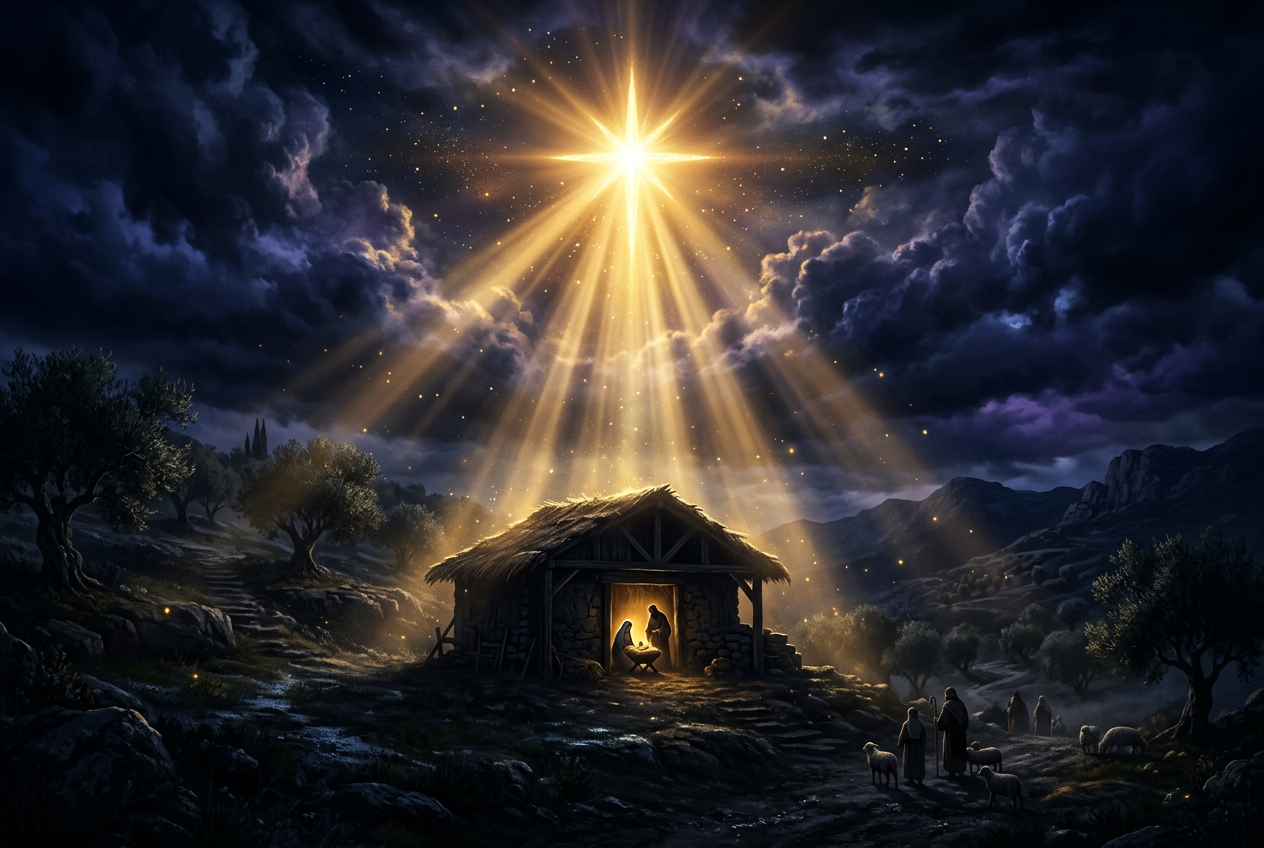
Most articles on this topic stop at the history and never get to the best part. The birth of Jesus was never a quiet, sentimental scene. Look closely and it reads like a kingdom announcement.
Who Were the Wise Men, Really?
Scripture says "wise men from the East came to Jerusalem, saying, Where is He who has been born King of the Jews? For we have seen His star in the East and have come to worship Him" (Matthew 2:1-2). We tend to picture a few gentle scholars. The reality was heavier.
As explored in a 2018 episode of the Discovering Truth podcast with Bride Ministries leader Todd Edwards, these wise men, the Magi, were not random travelers. They represented Parthia, the one kingdom in the ancient world strong enough to stand toe to toe with Rome. Their arrival to honor a newborn "King of the Jews" was not a private visit. It was a political and prophetic statement, and it explains why Herod was so shaken. The Magi were a priestly class from the East with long exposure to the prophecies of Daniel, so they were watching for exactly this.
What the Star Was Doing
The Bible treats the heavens as God's signboard: "The heavens declare the glory of God" (Psalm 19:1). He is personally involved with the stars: "He counts the number of the stars; He calls them all by name" (Psalm 147:4). He alone governs them, as He reminds Job: "Can you bring out Mazzaroth in its season?" (Job 38:32). Mazzaroth is an old word for the constellations.
From the Bride Ministries perspective, the star that led the Magi was not merely a natural astronomical event, but part of God's deliberate orchestration to announce His Son. You do not have to nail down every question about that star to catch the point. God was speaking, and the right people were listening.
Types and Shadows in the Gifts
Even the gifts preached a sermon. "They presented gifts to Him: gold, frankincense, and myrrh" (Matthew 2:11). Gold is the gift for a king. Frankincense was used by priests. Myrrh was used to prepare bodies for burial. King, priest, and sacrifice, all handed to a baby. This is who He is. Isaiah had already declared it: "For unto us a Child is born, Unto us a Son is given... And His name will be called Wonderful, Counselor, Mighty God, Everlasting Father, Prince of Peace" (Isaiah 9:6). Micah had already named the town: "But you, Bethlehem Ephrathah... Yet out of you shall come forth to Me The One to be Ruler in Israel" (Micah 5:2). None of it was random.
So, Should Christians Celebrate Christmas?
So the verdict comes back, and it is honest. The Bible does not command Christmas, and the Bible does not forbid it. Bride Ministries will not hand you a rule where Scripture hands you freedom.
Paul already handed down the ruling: "Let each be fully convinced in his own mind" (Romans 14:5). If you celebrate, celebrate to the Lord. If you choose not to, that too can be to the Lord. What matters is not the date. It is the devotion behind it. As Paul wrote, "To the pure all things are pure" (Titus 1:15). A heart set on Jesus is not made pagan by a calendar.
One gentle note. If Christmas sits heavy on you personally, painful memories, or a spiritual heaviness you cannot name, that is worth bringing to God rather than gutting it out on willpower alone. Bride Ministries keeps more than a hundred free prayer resources for exactly that kind of quiet work.
So the charge against December 25 collapses, and the question "is Christmas a pagan holiday" turns out to be less about a date and more about where your heart is pointed. Jesus said it Himself: "I am the light of the world. He who follows Me shall not walk in darkness, but have the light of life" (John 8:12). The Light of the world does not flinch at a quarrel over the calendar. When the angel first broke the news to shepherds in a field, the word was not fear. It was joy: "I bring you good tidings of great joy which will be to all people. For there is born to you this day in the city of David a Savior, who is Christ the Lord" (Luke 2:10-11). That was always the point. Not a holiday. A rescue.
Take the Next Step Toward Healing
Start Your Healing Journey