Why You Are Still in Chains After Praying (And How to Break Free)
You have prayed. You have repented. Maybe you have sat in church for years, gone forward at the altar, cried out to God more times than you can count. And still, something holds. The same struggle circles back. The same heaviness settles in. You feel stuck, and you do not understand why prayer has not set you free.
If that is you, this is not a sign that you lack faith or that God has passed you by. Bride Ministries has spent over a decade sitting with people who feel exactly this way. There is a reason chains persist, and there is a biblical way they come off. Breaking chains is not about praying harder. It is about understanding what is actually holding you and dealing with it at the root.
What Does "Breaking Chains" Mean in the Bible?
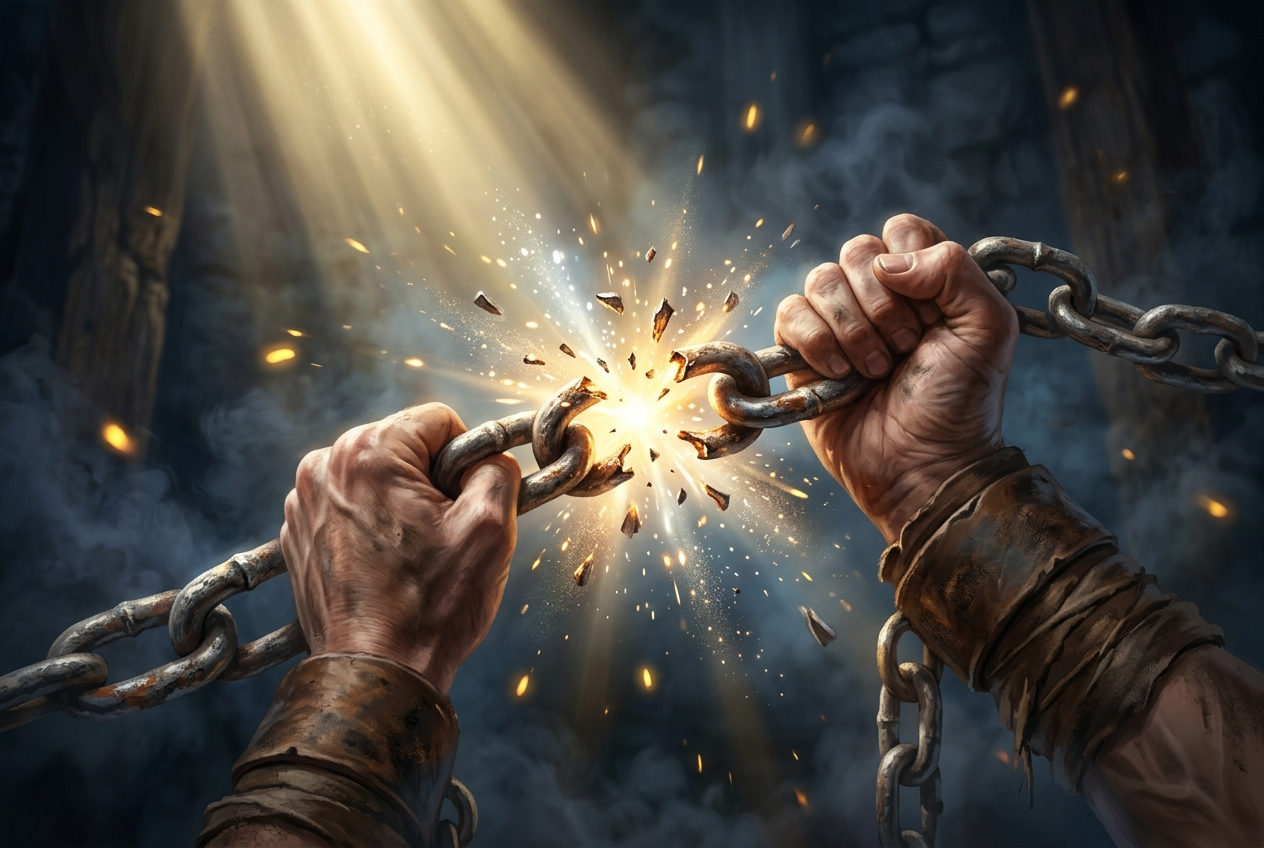
Chains show up all through Scripture as a picture of spiritual bondage. The psalmist describes a God who rescues His people: "He brought them out of darkness and the shadow of death, And broke their chains in pieces" (Psalms 107:14, NKJV). The prophet Isaiah describes the kind of fast God actually wants, one that sets people loose: "Is this not the fast that I have chosen: To loose the bonds of wickedness, To undo the heavy burdens, To let the oppressed go free, And that you break every yoke?" (Isaiah 58:6, NKJV).
So the language is not just poetry. A chain is a real thing that binds a real person. Today those chains show up as patterns you cannot shake, fear that runs your life, addictions that outlast every promise to quit, or a heaviness that has followed you since childhood. Something is holding on. The question is what, and why it has a grip.
Why Are You Still in Chains After Praying?
Here is the piece most teaching leaves out: not every chain is the same kind, so not every chain breaks the same way. Many people assume that if they believe in Jesus, no spiritual chain can touch them. But the deeper you look, the clearer it becomes that a believer can still carry real bondage. The apostle Paul told free people to stay free: "Stand fast therefore in the liberty by which Christ has made us free, and do not be entangled again with a yoke of bondage" (Galatians 5:1, NKJV). You cannot warn free people about getting tangled again unless it is possible.
Daniel Duval, founder of Bride Ministries, teaches that most chains stay in place because of a legal right. A legal right is simply this: a claim the enemy holds against a person that gives him permission to stay. Think of it like a door that was opened and never closed. As long as the door stands open, prayer that only pushes at the darkness will not finish the job, because the darkness has a reason to be there.
That reason usually traces back to one of three things: sin, transgression, or iniquity. Sin is missing the mark. Transgression is a settled, repeated defiance. Iniquity is something deeper still, a bent or twist that can be carried down a family line. Standard repentance deals with sin. Iniquity often needs more, and this is why sincere people can confess the same thing for years and still feel bound. Bride Ministries covers this in depth in Iniquity Resolved. The Ultimate Key to Freedom.
How Spiritual Chains Get Into a Person
If chains have a cause, it helps to know how they get in. There are three common doors.
The first is unconfessed sin and habitual defiance. When something wrong is chosen and never brought to the light, it can become an open door.
The second is iniquity that runs in the family line. Scripture speaks of God "visiting the iniquity of the fathers upon the children to the third and fourth generations of those who hate Me" (Deuteronomy 5:9, NKJV). Read that carefully, because it matters pastorally: this is not blame. If a chain came down your bloodline, it is not your fault. It is an inherited claim, and an inherited claim can be broken through what Jesus did.
The third door is deep wounds. Daniel Duval teaches that the heart, the deepest part of a person, gets shaped in three ways: through revelation, through repetition, and through wounding. When something painful happens early and cuts deep, it can install a pattern far below the level where you make conscious choices. That is why willpower and even sincere belief sometimes do not reach it. The wound sits underneath. You can want freedom with everything in you and still feel held, because the thing holding you was never at the surface to begin with.
The Biblical Way to Break Chains
Breaking chains follows an order. Skip a step, and the chain often snaps back.
The first move is to close the door. Confess what needs confessing, turn from it, and renounce it out loud. This is what removes the legal right, the enemy's permission to stay. Scripture describes exactly this kind of cancellation at the cross: God, "having wiped out the handwriting of requirements that was against us, which was contrary to us. And He has taken it out of the way, having nailed it to the cross" (Colossians 2:14, NKJV). The paperwork against you was nailed to the cross. That is the ground you stand on.
The second move is to bind. To bind a spirit is to cut off its ability to operate. Jesus described it plainly: "No one can enter a strong man's house and plunder his goods, unless he first binds the strong man. And then he will plunder his house" (Mark 3:27, NKJV). But here is a distinction most people miss: binding is not the same as casting out. Binding stops the activity. It does not evict. Many pray a binding prayer and assume the work is done, when it has really only begun. (Bride Ministries teaches more about the one holding the house in the companion article, Who Is the Strong Man in the Bible.)
The third move is to cast out, the actual eviction. Jesus gave His people this authority: "In My name they will cast out demons" (Mark 16:17, NKJV). This is a separate act from binding, and it works cleanly only when the legal right has already been closed. Evicting a spirit while the door still stands open is why some deliverance does not hold.
For chains that go deeper, Daniel Duval teaches an approach he calls bringing your case before God as Judge. In plain terms, you come to God the way you would come to a fair court: you bring the wrong that was done, you point to what Jesus already paid, and you ask Him to rule. Because the payment is already made, the verdict has already been secured. Scripture says God's people "overcame him by the blood of the Lamb and by the word of their testimony" (Revelation 12:11, NKJV). Bride Ministries walks through this fully in its teaching on the Courts of Heaven.
For chains that came down a family line, the same principle applies. You take responsibility on behalf of your line, you ask God to break the inherited claim, and you stand on the cross as the payment. Isaiah names the payment: "He was wounded for our transgressions, He was bruised for our iniquities" (Isaiah 53:5, NKJV). Wounds, transgressions, and iniquity were all covered there.
The Truth That Makes Freedom Possible
None of this is about performing the right ritual. Your freedom was already bought. Scripture says Jesus "Himself bore our sins in His own body on the tree" (1 Peter 2:24, NKJV). The provision exists. Your part is not to earn it but to enforce what He already won.
And this is where a lot of stuck people carry a quiet lie: the idea that if something has not changed, God must have decided against it. That is not how Daniel Duval reads Scripture. He teaches that God plays by His own rules, and prayer activates those rules. It is the reason Jesus told us to pray, "Your will be done On earth as it is in heaven" (Matthew 6:10, NKJV). If God's will were simply happening automatically, that prayer would make no sense. Heaven responds to prayer that means it: "The effective, fervent prayer of a righteous man avails much" (James 5:16, NKJV). You are not begging a passive God. You are enforcing a finished victory.
Why Deliverance Takes More Than One Session
Freedom usually comes off in layers. A person is not just an individual; they carry a family line, a history, seasons and places that shaped them. One prayer time may reach one layer and leave another untouched. Bride Ministries teaches that this is normal, not failure. Your earlier prayers were not wasted. They dealt with one part, and there is more to reach.
That is why lasting freedom is a process, not a single event. If a chain came back, it does not mean the prayer failed or that you are beyond help. It usually means the next layer is asking for attention. Bride Ministries explains this pattern in Deliverance Ministry: Why It's a Process, Not One Event.
Where to Start If You Feel Stuck
If you are tired, that makes sense. Carrying a chain nobody could explain is exhausting. But you are not without a next step. Sometimes what you need is a clear, practical way to pray, and Bride Ministries lays one out in Praying Spiritual Warfare Prayers: The 3-Tier System. Other times the thing holding you is a stronger kind of spirit that needs a different approach, which is covered in Freedom from Principalities: How to Get Free. And if you would rather have someone help you find the right starting point, the free assessment below points you to the right path in about two minutes.
Daniel Duval lays out the full prayer-and-legal framework in his book Prayers That Shake Heaven and Earth, and unpacks why chains sit so deep in the human heart in Awakened. The chain that has held you is not stronger than the cross. It has a cause, and the cause can be closed.
Take the Next Step Toward Healing
Start Your Healing Journey